

The State Treasury prepared an assessment memorandum on electronic business vouchers (e-invoices, Peppol procurement messages, eReceipts) in which it describes the regulatory options at different levels by business document group and their impacts on the development of the use of business vouchers. The assessment memorandum is related to the State Treasury’s task of promoting and developing electronic business vouchers as part of the Real-Time Economy ecosystem.
The opinions received on the assessment memorandum can be used for determining stakeholder views on the development of the use of business vouchers and the related legislation and other guidance. The assessment memorandum and the opinion procedure are not related to the ongoing legislative project.
The assessment memorandum and the questions concerning it were sent out for opinions via the opinion service (Lausuntopalvelu) on 2 February 2026, and parties were requested to submit opinions by 13 March 2026. The request for an opinion was sent to municipalities, wellbeing services counties, ministries and agencies through the Lausuntopalvelu. In addition, the request for an opinion was forwarded via the Real-Time Economy ecosystem’s cooperation groups to stakeholders involved in cooperation. The request for an opinion was also publicly available to everyone. A total of 47 parties submitted an opinion. The opinions submitted through the e-service can be viewed on the lausuntopalvelu.fi website.
Parties submitting opinions recognise the need for digitalisation, varied views on methods
Parties who submitted opinions were generally positive with regard to digitalisation and the utilisation of electronic business vouchers. Opinions differed on the use of legislation to develop the use of electronic business vouchers. Public sector actors were more in favour of regulatory steering more often than private sector actors, who showed more support for market-based progress rather than regulation. It is believed that the use of business vouchers will increase even without legislation, but the parties submitting opinions noted that the development will remain more uneven and slower than with supporting legislation.
Regulation of e-invoices receives support – Attention shifted to transition times and the extent of the obligation
Three different options were available for opinions on e-invoices:
- Extensive obligation, e-invoicing is always mandatory in invoicing between organisations
- Limited obligation, e-invoice compliant with the standard required when an e-invoice is used
- Market-based development, current legislation will remain in force
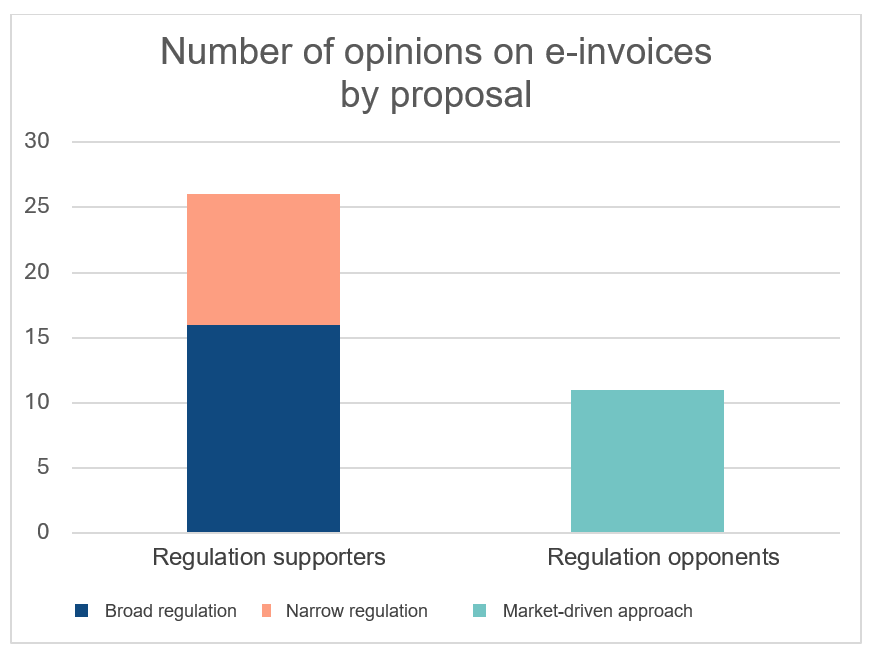
24 parties submitting an opinion were in favour of the development of e-invoicing with legislation and 11 parties opposed this. The opinions submitted by public sector parties were more in favour of (18) than opposed to (3) regulation, whereas in the private fewer were in favour of regulation (6) than opposed to it (8). Parties submitting an opinion believed that an invoice compliant with the European standard was generally a good solution.
The opinions emphasise the importance of an assessment of the obligation small enterprises would be subject to and support for their capabilities, as well as the determination of sufficient transition periods if legislative measures are taken. Impacts on consumers should be assessed in any further preparation. In addition, a more detailed assessment of the costs and benefits resulting for different parties due to being subject to obligations must be prepared.
Regulation of Peppol procurement messages divides opinions 50–50
There were three regulation options for Peppol procurement messages:
- Extensive obligation of public administration; steering by the authorities, operations of contracting entities in accordance with the Peppol procurement process upon request, and requirements for the Peppol interoperability of order systems
- Limited regulation; central government subject to the obligation to use Peppol procurement in suitable procurements, steering by authorities as commissioned by the government
- Market-based development
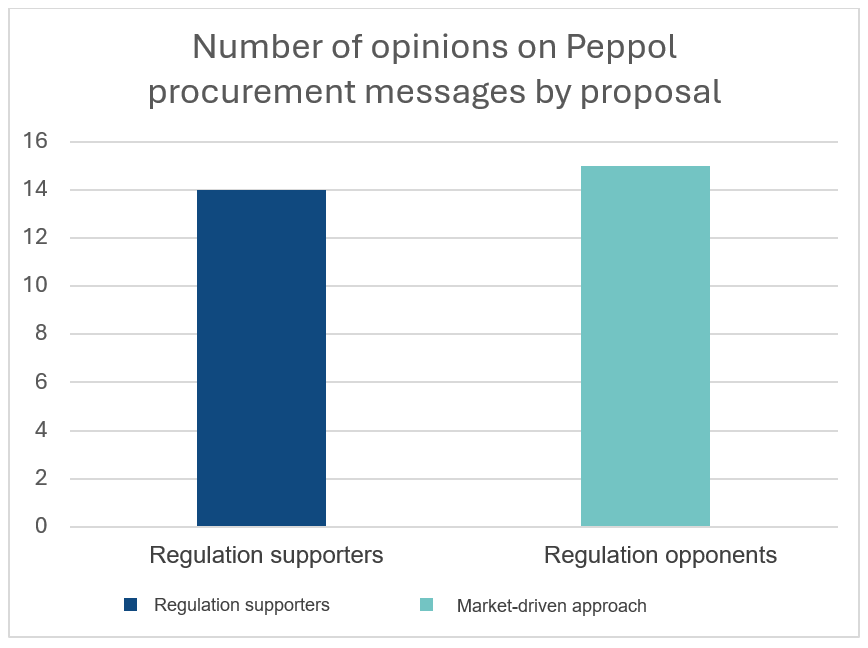
15 parties submitting an opinion were in favour of promoting the use of e-receipts with legislation and 15 parties opposed this. The opinions submitted by public sector actors were more in favour of regulation (13) than opposed (6) to it. The opinions submitted by the private sector showed less support (2) than opposition (9).
Parties submitting opinions who were in favour of legislation highlighted the broad benefits of Peppol procurement messages, such as a reduction in manual work and an increase in labour productivity, and the faster achievement of these benefits through legislation. The responses of those who opposed legislation emphasised the current low utilisation rate of Peppol procurement messages, varying practices for submitting orders, and the favouring of market-based development and information steered methods instead of legislation. In general, the responses revealed that most were in favour of the public sector or central government leading the way in introducing Peppol procurement messages.
The regulatory proposals for Peppol procurement messages differed from those for the other two other types of vouchers, which makes it difficult to itemise the content of statements that support regulation. For this reason, it is a good idea to talk about parties in favour of regulation and parties opposed to regulation in general when it comes to procurement messages.
E-receipt regulation proposals gained support – low utilisation rate a burden
The three regulation options for e-receipts were:
- Extensive regulation; Offering a structured e-receipt if another type of electronic receipt is available
- Limited regulation; Paper receipt only separately upon request, obligation of contracting entities to receive and send e-receipts
- Market-based development
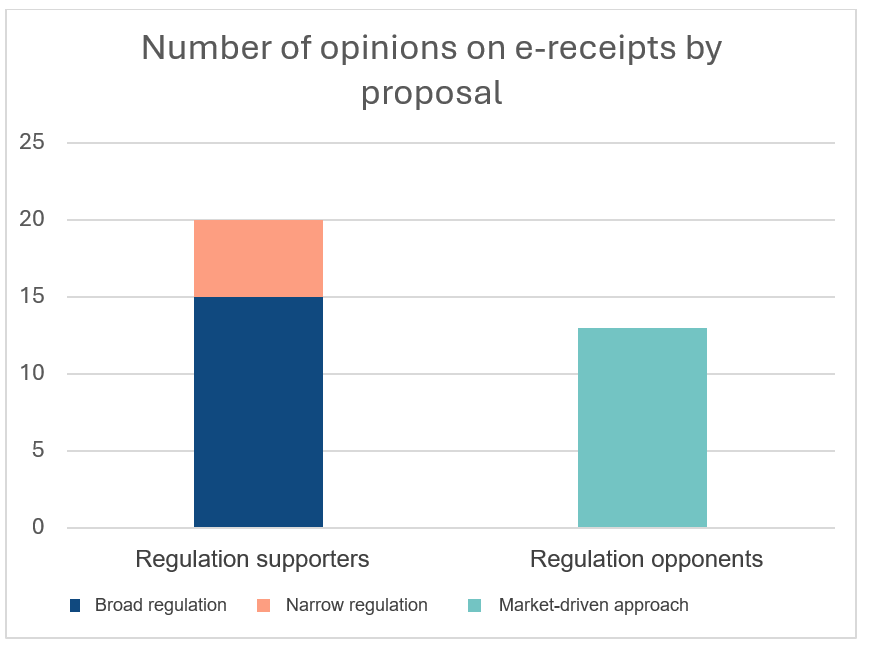
19 parties submitting an opinion were in favour of promoting the use of e-receipts with legislation and 13 parties opposed this. The opinions submitted by public sector actors were more in favour of (13) than in opposition to (4) regulation, whereas in the private sector, regulation received less support (6) than opposition (9).
Parties submitting opinions stated that the utilisation rate of e-receipts is still low, as the scanning of receipts is widely used and structured data is not yet fully utilised. Several statements emphasised the provision of information on the benefits of e-receipts to promote the increase of their use. The opinions emphasised the potential benefits of the e-receipt, but also the opportunities provided by new technologies, the need to assess data protection issues and the concentration of the current market situation.
The role of the authorities in the development of business vouchers
In addition, the request for an opinion asked what kind of role central government should play in promoting and developing the use of electronic business vouchers. Opinions submitted by both the public sector and the private sector mention the role of central government as a trendsetter and an example.
The opinions highlight a guiding, coordinating, facilitating, enabling and developing role instead of the central government merely dictating the use of certain solutions. The opinions also mention ensuring interoperability and continued security of supply. Parties submitting opinions expressed that they would like for the central government to cooperate with various parties on developing the use of business vouchers.
Digitalisation with or without regulation?
Based on the opinions received, digitalisation is seen as significant for the nation and to some extent already as part of everyday life. Parties submitting opinions believed that more stringent regulation would accelerate the introduction of different digital capabilities, decrease the fragmentation of operating methods and ultimately bring more companies to digital services and that these spoke in favour of more regulation.
Opinions that were in favour of a market-based approach indicate the need to reduce regulation directed at companies, to increase flexibility in the development of services and to utilise the models that have been produced for e-invoicing in Finland, also for other types of vouchers.
In addition, several opinions highlighted various concerns related to regulation. How can small businesses be guaranteed the ability to use electronic vouchers if regulation is increased? How does consumer trade compare with regulation between organisations? How can technology neutrality be ensured if there are few actors?
The parties submitting opinions also highlighted sufficiently long transition periods, the coordination of possible regulation timetables with other legislative projects, such as the entry into force of the VAT in the Digital Age Directive.
State Treasury to submit the provided opinions to the ministry for further processing
The State Treasury prepared an assessment memorandum to assess the need for legislative steering of the tasks assigned to the agency. This work is now ready after a round of opinions and the processing of the feedback, and the data will be handed over to the ministries for further assessment. For their part, the ministries will assess whether legislative work needs to be included in legislative drafting or whether it should be added to the next Government Programme.
The State Treasury would also expressly like to thank all parties who submitted opinions!
Summary of the assessment memorandum on electronic business vouchers (in Finnish) (pdf)