

Peppol Authority
The State Treasury is the Finnish Peppol Authority, and it is responsible for promoting and supervising the use of the Peppol Network in Finland.
The State Treasury is the Finnish Peppol Authority, and it is responsible for promoting and supervising the use of the Peppol Network in Finland.
Peppol is an open network through which different parties can transmit electronic business documents to each other in a standardised, sector-independent manner. Electronic business documents include catalogues, orders and order confirmations. The Peppol network is available through a Peppol Service Provider. The majority of Finland’s most important trading partners are promoting the use of Peppol in their territories.
OpenPeppol AISBL is an international non-profit association registered in Belgium and under Belgian law, and it includes members from both the public and private sector. OpenPeppol is responsible for developing, maintaining and implementing the specifications, operating model and services of the Peppol network.
The Peppol network and its Advanced Ordering documents were introduced in central government on 1 April 2024. Read more about Advanced Ordering.
The parties to the Peppol Network are:
The Finnish Peppol Authority is the State Treasury, which promotes the use of the Peppol network in Finland. The Peppol Authority supports and supervises Peppol Service Providers, monitors the development of national legislation, coordinates training opportunities, and enhances Peppol-related competence. The Peppol Authority also participates in and influences the development of the international Peppol Network. The development work is carried out openly and in close collaboration with the network’s stakeholders.
For a summary of each national Peppol Authority, visit this link.
The core task of Peppol Service Providers is to operate as Access Points between the Peppol Network and its end users. Peppol Service Providers can also maintain part of the Peppol Address and Capability Lookup (ACL) service. An end user can join the Peppol Network through a Peppol Service Provider. The Service Provider transmits the end user’s electronic business documents, ensures that the end user’s Peppol address is entered in the address book, and is responsible for providing support.
For a list of certified Peppol Service Providers, visit this link. The country of a Peppol Service Provider refers to the country in which it primarily operates. However, the use of the network does not depend on the Service Provider’s country.
The term ‘end user’ refers to an organisation that sends and receives electronic business documents, such as orders or invoices. Peppol Service Providers transmit electronic business documents between end users. End users do not need to join OpenPeppol in order to send or receive Peppol-compliant documents. An end user can join OpenPeppol if they wish to influence the development of the Peppol Network.
A party wishing to join the network must join the OpenPeppol Association. OpenPeppol AISBL is an international, not-for-profit association registered in Belgium with members from both the public and private sector. The OpenPeppol Association is responsible for developing, maintaining, and implementing the specifications, operating model, and services of the Peppol Network. OpenPeppol’s website is available here.
For decades, companies have used various sector and company-specific solutions to send electronic documents. For example, retailers, industrial companies and importers have used procurement messages with their suppliers. However, the exchange of these electronic documents has been based on bilateral connections, the construction of which is laborious and cost-inefficient for many organisations.
In Peppol, the exchange of information is based on a network-like model. This means that an organisation can use one connection to communicate with every other organisation in the same Peppol network. This model enables the cost-effective deployment of electronic documents across the entire business and public sector. The digitalisation of business documents is a must for Finnish companies that wish to remain competitive in the Nordic and European marketspace.
Peppol is designed for companies and organisations of all shapes and sizes. If your company wishes to begin using Peppol, you can contact your system vendor or Peppol Service Provider.
To begin using Peppol at your company, you must have:
Still confused? Think of it this way: The Peppol Network’s operating model is similar to using a phone: to make and receive calls, you need a phone (in Peppol, a system or service) and a subscription with an operator (in Peppol, a Peppol Service Provider). However, instead of calls, your Peppol Service Provider forwards the electronic documents created in your system to any recipient in the world, from Finland to Australia.
The Peppol Authority’s monitoring group meets every month to discuss topical issues. The monitoring group is open to everyone. If you would like to join us, just send an email to: peppol@valtiokonttori.fi.
The Nordic Peppol Authorities facilitate the Nordic Peppol Construction Industry Forum. If you would like to learn more and join the forum, visit this link.
Peppol Service Providers are OpenPeppol members that have concluded a Peppol Service Provider Agreement with a Peppol Authority. The core task of Peppol Service Providers is to operate as Access Points between the Peppol network and their customers. A Peppol Service Provider can also maintain part of the Peppol address and capability lookup service (ACL).
A Peppol Service Provider concludes a Service Provider Agreement with the Peppol Authority of the country in which it mainly operates. This does not undermine the international character of the Peppol network. Service Providers can have customers in any country. In this case, however, any Authority Specific Requirements for Peppol use imposed by the Peppol Authorities in each country must be met (Peppol Authority Specific Requirements). See below for the Peppol Authority Specific Requirements in Finland. The Peppol Authority Specific Requirements apply to all Service Providers with end customers in the country in question. If a Finnish Peppol Service Provider has Norwegian customers, for instance, they must also comply with the Peppol Authority Specific Requirements laid down by the Norwegian Peppol Authority.
A Peppol Access Point refers to a system operated by a Peppol Service Provider for the transmission of business documents over the Peppol network. The operation of the Peppol network is based on a four-corner model. This means that the end customer must only set up a connection with a single Peppol Service Provider’s Access Point, through which they can reach all parties that have joined the network.
OpenPeppol has specified how the Access Points should be able to communicate with each other. Read more about the specifications and instructions on OpenPeppol website. A Service Provider can build their Access Point from a scratch themselves or use one of the ready-made solutions listed by OpenPeppol.
Peppol’s address directory is decentralized. The Service Metadata Locator (SML) service managed by OpenPeppol participates in the operation of the address directory. In addition, there are numerous decentralised Address and Capability Lookup (ACL) services maintained by Peppol Service Providers. Service Metadata Publisher (SMP), which is the old name for ACL, still comes up in some OpenPeppol materials. The Finnish Peppol Authority maintains Finland’s national ACL directory. For more information about this topic, see below.
Service Providers maintain their customers’ Peppol addresses and information about which business documents they can process in the ACL service. The ACL service also contains information on which Service Provider’s Access Point the business document must technically be delivered to in order to ensure that it reaches the correct recipient. The SML service is used to determine the ACL service in which the end customer’s data are maintained. OpenPeppol maintains more detailed documentation on both ACL and SML operation.
Figure 2, ‘Endpoint lookup with Service Metadata’ in the more detailed ACL documentation is a good illustration of how the address directory operates.
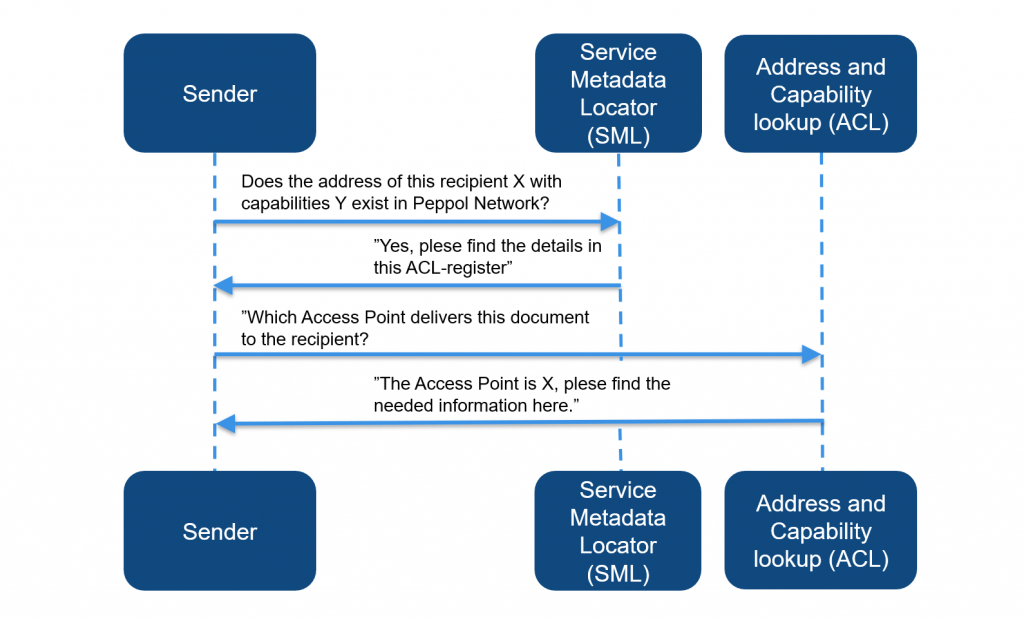
The national ACL directory (also known as SMP) is maintained by the Finnish Peppol Authority. Finland’s Authority Specific Peppol Requirements contain provisions on the use of the national ACL directory. The addresses of Finnish public sector organisations must be maintained in the service. Should they wish, a Peppol Service Provider may also maintain the addresses of other Finnish organisations in the service. Using the service is free of charge for Peppol Service Providers.
Finland’s national ACL directory has been integrated into the verkkolaskuosoite.fi service maintained by TIEKE. This integration enables an easy way for end users to retrieve organisations’ Finnish e-invoicing addresses and Peppol addresses from a single location.
Finland’s national ACL directory will be commissioned on 1 February 2024. The transition period within which the Peppol addresses of Finnish public sector organisations must be found in the service ends on 1 August 2024.
In order to use the service, a Peppol Service Provider must accept its Terms of Use
The Service Provider fills in the information of its organisation in the terms of use document and e-mails it to peppol@valtiokonttori.fi. The Peppol Service Provider must have at least one Finnish customer organisation in order to get access rights to the service. Additionally, a Peppol Service Provider must not be subject to sanctions imposed by the European Union or the UN.
The ACL directory is used through APIs. You can view the API description here. Finland’s national ACL directory is based on an open source code phoss SMP implementation.
Once a Peppol Service Provider has accepted the terms of use and meets the requirements for using the service, they will be granted access rights to it. They also get access to the support channel of the service at this time. The support channel can only be contacted by the designated contact person confirmed by the Service Provider in advance. The support service can be contacted through the support portal or by e-mail. Detailed information will be provided to the Peppol Service Provider at the time of deployment.
For questions related to becoming a Peppol Service Provider, you can contact the Finnish Peppol Authority by email at peppol@valtiokonttori.fi
To become a Peppol Service Provider, you must meet OpenPeppol requirements. OpenPeppol provides a test bed for this purpose. Read the instructions for passing the required tests on Peppol’s website.
The certificates expire in two years, after which they must be renewed.
Peppol address (Peppol Participant Identifier)
Finnish organisations shall use an OVT code as their actual address in the Peppol network. An OVT code is formatted as 0216:003712345678ABCDE, where:
Examples
Example-Enterprise Oy:
Business ID: 1234567-8
OVT code: 003712345678
Peppol address: 0216:003712345678
Example-Business Oy:
Business ID: 8765432-1
OVT code: 003787654321ENNI1
Peppol address: 0216:003787654321ENNI1
In XML format, the address could look like this:
<cbc:EndpointID schemeID=”0216″>003787654321ENNI1</cbc:EndpointID>
You can download the 0216 OVT code specification here.
Your Peppol Service Provider will make sure that your Peppol address is entered into the ACL directory.
Peppol Authorities can set requirements for the usage of Peppol in their jurisdiction. These Peppol Authority Specific Requirement apply to all Service Providers who have Finnish end users as customers for their operations in Finland.
The requirement are also availabel on the Peppol webiste.
Finnish End Users must only use the Finnish OVT code as their Peppol participant identifier. The OVT Code’s ICD value is 0216.
You can download the 0216 OVT code specification here. If the Finnish End User’s Business Identity Code (Y-tunnus) changes, the End User’s OVT code must be updated to match the new Business Identity Code.
Service Providers must verify that their Finnish End Users Business Identity Code is listed in the Finnish Patent and Registration Office maintained registry (https://www.ytj.fi/) to ensure that the End User is registered. Service Providers must verify the authority of representation of their customers from the official trade register extract of the customer or from other equivalent document proving the representation rights. It is recommended that Service Providers are compliant or have an ISO27001 certification for their Peppol services.
The Peppol Participant identifiers of the Finnish Public sector organizations must be registered in the Access and Capability Lookup registry (ACL) managed by the Peppol Authority of Finland. The Finnish Public sector organizations that must be registered are:
Service Providers can apply to get access to the ACL by contacting peppol@valtiokonttori.fi.
The Service Provider must meet the requirements set by the Peppol Authority of Finland and accept the terms of use. Details about these requirements can be found in the terms of use (Finnish, English, Swedish).
Service Providers must implement the End User’s request for Participant Identifier or Service Provider change within three working days, taking into account possible Service Provider and End User contract requirements.
The purpose of sector-specific application guides is to facilitate the deployment and use of Peppol messages in different sectors. They make it easier for different parties, such as end users and system vendors, to identify the Peppol processes, messages, and code lists that are central to their respective fields. An application guide may not violate Peppol’s interoperability principle. If any shortcomings are detected during the preparation of an application guide that cannot be resolved in that guide, the Peppol Authority can submit an official change proposal to OpenPeppol.
Each application guide must be prepared for a concrete purpose, and it must always be done in collaboration with the parties in the sector and the Finnish Peppol Authority. The parties representing the sector do most of the work themselves, which is why their commitment to the work is essential. To get started, contact the Peppol Authority at peppol@valtiokonttori.fi.
The application guide for Peppol orders in the retail sector is available here.
The application guide was prepared in cooperation with the Finnish Commerce Federation, SOK, Kesko, Maalarimestarien Oy, and the Peppol Authority. The application guide covers the following Peppol processes: BIS Order Only, BIS Ordering, and BIS Despatch Advice.
If you wish to propose any changes, please contact the State Treasury at peppol@valtiokonttori.fi.
The central government’s detailed instructions for using the Advanced Ordering process in Peppol are available here.
The instructions specify the processing of Class A and B changes due to the special requirements set by the central government. Any Class A changes will always result in the cancellation of an order, while Class B changes are left to the discretion of the party who placed the order. The instructions also list the minimum data requirements for Peppol messages, with sample XML messages for reference.
The application instructions are intended to assist the central government’s suppliers and application providers in the deployment of Peppol procurement messages within the central government.
Peppol BIS Billing is an e-invoicing format that complies with the European Standard (EN 16931). The latest versions of Finland’s national e-invoicing formats (Finvoice 3.0 and TEAPPSXML 3.0) can also be used to create European Standard-compliant e-invoices. For more information about the European Standard, visit this link (available in Finnish).
You can download the compatibility table for Peppol and Finvoice here. The compatibility table for Finvoice and TEAPPSXML is available on Finance Finland’s website.
OpenPeppol collects monthly end user and transaction statistics from the Peppol Service Providers. Each Peppol Authority gets a country specific report. These reports include the total amount of sent and received Peppol transactions per document type and the amount of active end users in the jurisdiction. The report also includes statistics of the Service providers operating in the jurisdiction.
The Finnish Peppol Authority publishes a summary report from this data quarterly.