Recent years have transformed the landscape of e‑invoicing. What was once a novelty has become a core capability for any software handling invoices. The wave of new laws and mandates introduced across many countries has triggered a surge in compliance‑related services. Companies now face a critical question: how can they ensure they meet the regulatory requirements of every country they operate in? For multinational organisations, the challenge is even greater as they must comply with multiple regulatory frameworks simultaneously.
Less attention, however, has been given to the fact that even companies without foreign subsidiaries often operate across borders. Business today rarely stops at the edge of a map. The rise of e‑invoicing in neighbouring countries, or even in more distant markets where trade is active, should be seen as an opportunity rather than a burden. The same benefits that e‑invoicing brings to domestic trade – efficiency, time savings, enhanced automation, improved data quality and stronger business relationships – apply equally to international transactions.
In this article, we focus on Finland and Germany.
Finnish customs statistics
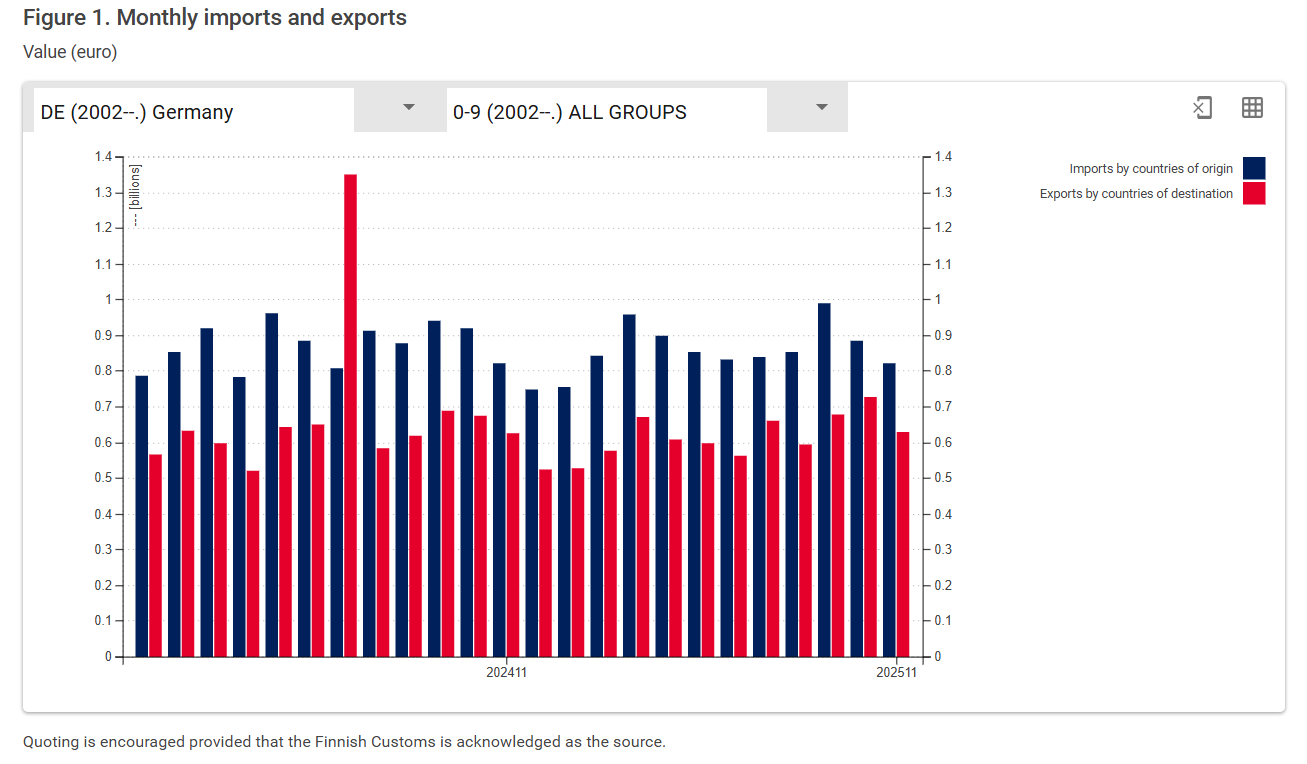
According to statistics provided by Finnish Customs, trade between Finland and Germany is highly active, as shown in the report below. Germany is one of the largest export and import markets for Finnish companies, and Finland imports more goods from Germany than it exports.
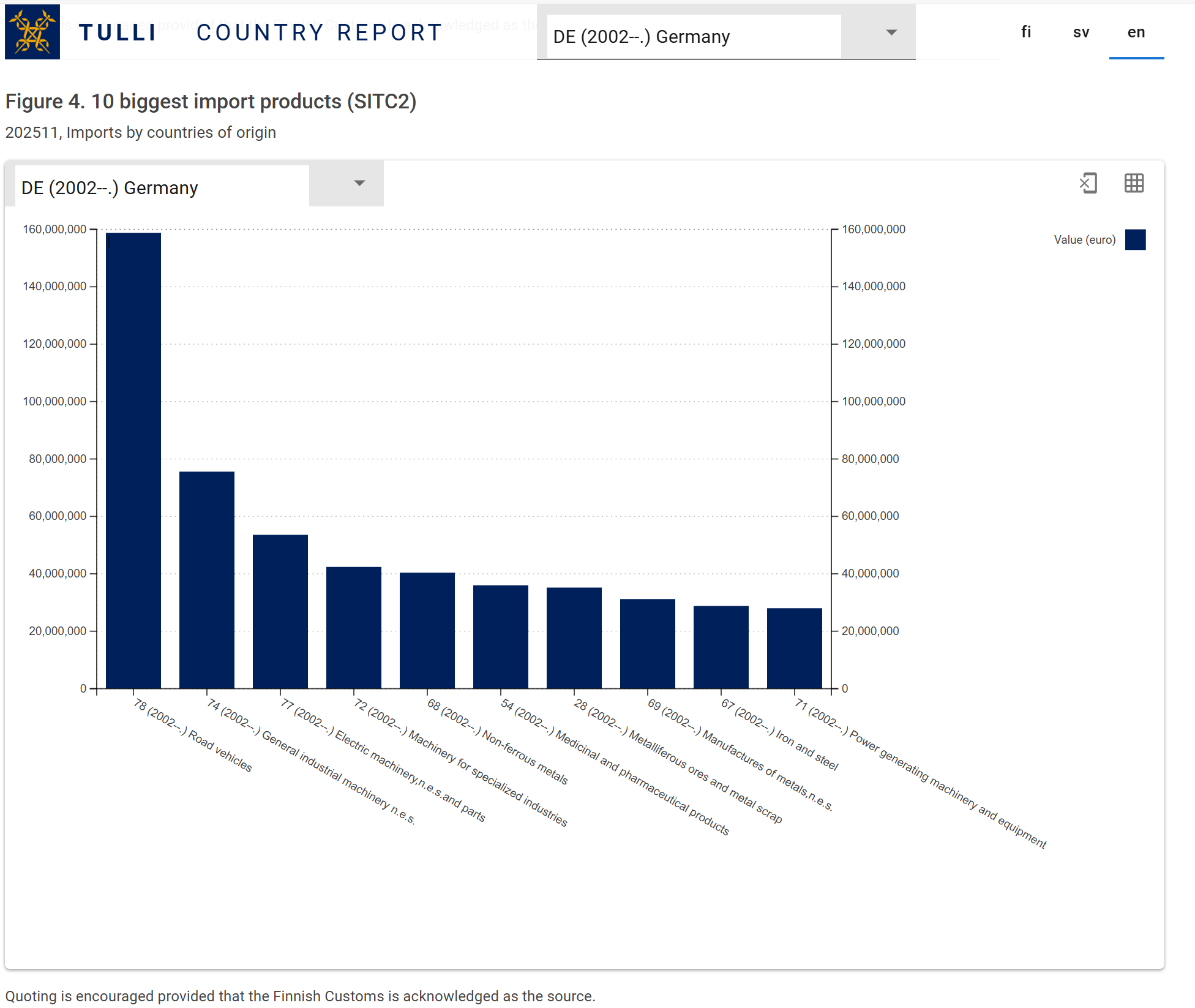
The most imported goods vary from month to month, but in November 2025 the largest product categories imported from Germany to Finland were vehicles, various types of industrial and electrical machinery, nonferrous metals and medicinal and pharmaceutical products.
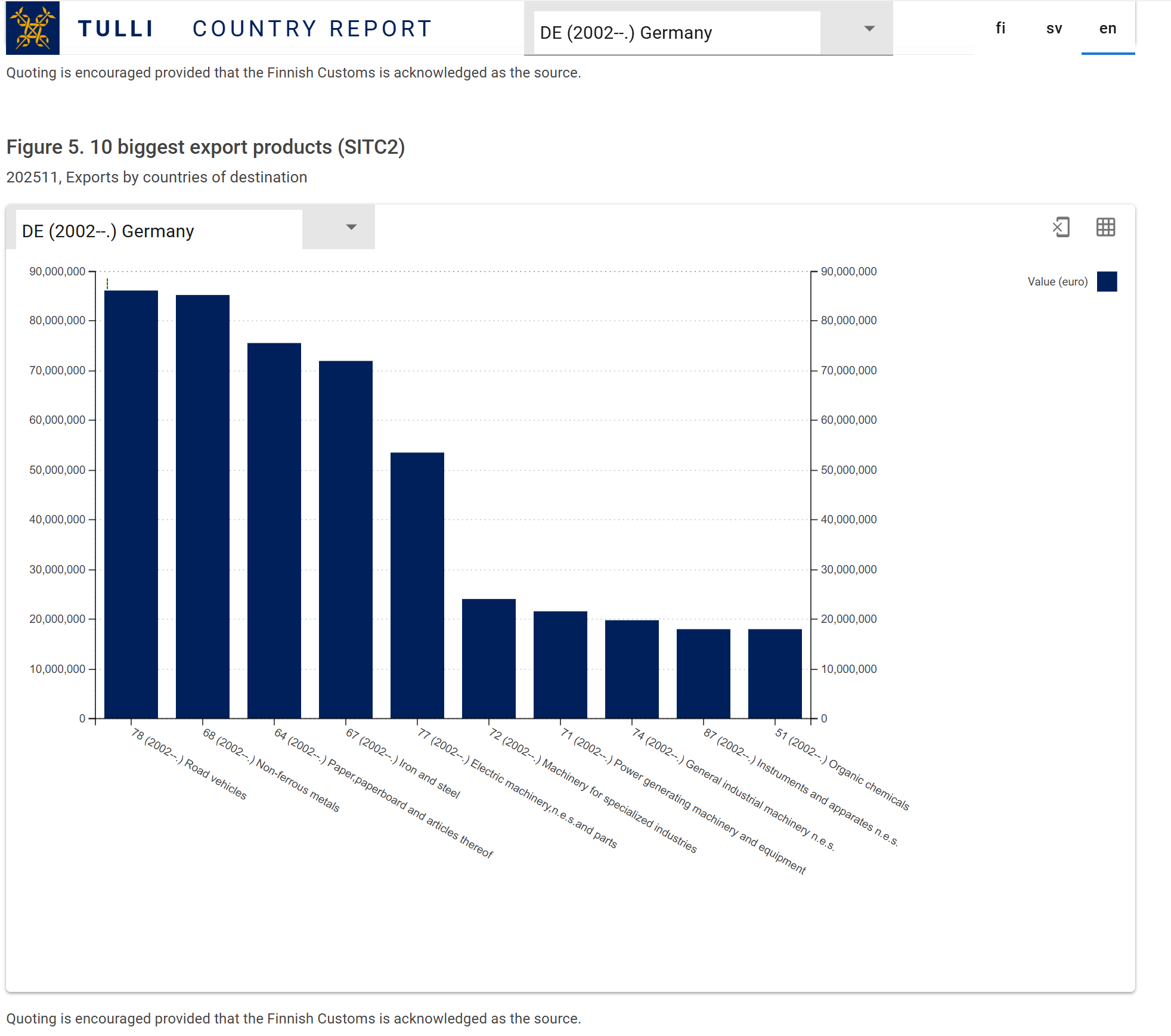
The largest product categories exported from Finland to Germany were vehicles, nonferrous metals, paper and paperboard, iron and steel, and electrical machinery.
Peppol transaction statistics
The numbers of the Peppol transaction statistics between Finland and Germany have not been published, but we can share some analyses based on them. The statistics do not show the actual volume of trade taking place between the two countries. For example, Germany and Sweden are relatively close to each other in Finland’s import and export figures, yet in the Finnish Peppol transaction statistics Sweden is larger by a wide margin. There is clearly still significant room for growth.
Starting from Q3 of 2025, a slight increase can be observed. Transactions sent from Germany to Finland are higher than those sent from Finland to Germany.
To understand why the situation is as it is, we need to take a closer look at the e‑invoicing history and models of each country.
Finland – e-Invoicing
Finland is an interesting case, with more than 25 years of experience in einvoicing. Over the years, the usage rate of einvoices has grown steadily. Currently, more than 90 percent of all invoices are einvoices, amounting to 325 million einvoices per year across B2G, B2B and B2C transactions. In the Finnish national einvoicing registry, more than 370,000 companies have registered their einvoicing capabilities. That is a significant number in a country with a population of just 5.6 million people.
The vast majority of einvoices in Finland are transmitted through a national einvoicing network using the domestic formats Finvoice and TEAPPSXML. The national system supports B2G, B2B and B2C transactions, and both domestic formats are EN16931 compatible. Given the long history, there are still some legacy systems in use that rely on older versions of the invoice formats, which can occasionally complicate matters.
The system works well overall, but it can appear challenging from the outside. For a foreign company trading with a Finnish business, the question often is: Which address should I send the einvoice to? If Finnish companies use einvoices in domestic trade, surely, they can also use them with us.
As you might have guessed, the answer is Peppol. Finland is relatively new to Peppol, as the Peppol Authority was established only in 2023. The number of Finnish end users who have registered their Peppol capabilities in the Peppol Directory is just 13,000, with a total of 780,000 transactions per year. This is quite a gap compared to the 370,000 registered companies and 325 million transactions in the national network.
However, the situation is not as bleak as it may seem at first glance. The number of Peppol transactions in Finland grew by 60.6 percent last year. Most companies in Finland already use systems that are capable of einvoicing; they simply have not connected to Peppol because einvoices have not been widely used in many parts of the world, and the default solution in crossborder trade has traditionally been the PDF invoice.
Most Finnish national einvoicing service providers are also Peppol service providers, so the switch is relatively straightforward. The national formats can be easily converted into Peppol invoices and vice versa. All Finnish companies may need is a small push from their foreign trading partners to activate their Peppol capabilities. This is an opportunity we should not miss.
Germany – e-Invoicing
In terms of population, Germany is 15 times larger than Finland. The number of companies is approximately 3.5 million. Germany is a country that embraces innovation, yet at the same time tends to hold on to established structures and procedures. This is also evident in the exchange of invoices: the cultural shift from paper invoices to structured electronic invoices, which can be processed efficiently through seamless machinetomachine communication, is far from complete. Many business owners and, unfortunately, even some association and trade representatives, find this transition difficult and season it with a touch of nostalgia.
Nevertheless, there has been significant progress in Germany as well. The national standard XRechnung has been in place for more than 10 years, created specifically to facilitate communication between the private sector and the public sector. The EN 16931compliant XML format has gained considerable attention and widespread national adoption in recent years and is increasingly used in B2B settings.
Almost simultaneously with the development of the technical standard, work was underway to harmonize the transport layer. In Germany, the decision was made to opt against an existing national solution in favour of the European, and now international, Peppol standard. The case for Peppol was not only its crossborder perspective, but also, and especially, the fact that it focuses not just on the structured electronic invoice but on the entire procurement process. The electronic invoice is only the beginning. This is also reflected in various projects launched in Germany in recent years, which we will present at Peppol Day in Helsinki.
The Peppol network has been growing steadily in Germany since 2018, particularly over the past two years. This positive trend is driven by European requirements for transmitting VAT data to tax authorities: all companies in Europe must gradually begin exchanging invoices in a defined, structured format. In Germany, additional momentum and attention have come from the Growth Opportunities Act, which in some areas calls for even more ambitious implementation.
Despite these favourable conditions, the cultural shift away from colourful, customdesigned invoices on sturdy paper remains challenging and is often accompanied by fears of government surveillance and a loss of control. These concerns are serious, but they must not be allowed to permanently hinder the digitalisation of the business world.
In Germany, the Peppol network is now widely used and well known, at least judging by the number of Peppol service providers. The number of transactions is growing, although there is still plenty of room for further expansion. For crossborder trade, the Peppol network can be used with virtually no additional national requirements. While the XRechnung format continues to play an important role domestically, Peppol BIS Billing is used for crossborder exchanges.
So the infrastructure is in place for efficient and futureproof data exchange. Make use of it – and feel free to contact us if we can support you.
Written by: Hannu Kivinen, the Peppol Authority of Finland, and Beate Schulte, Head of Peppol Authority of Germany (KoSIT)
More on the subject
To learn more about the possibilities of using Peppol in crossborder cases, join Peppol Day Finland 2026 on 21 April 2026, where Beate Schulte from the Peppol Authority of Germany (KoSIT) will give a presentation on Peppol in Germany – not just einvoicing! together with her colleague Dr. Lars RölkerDenker, Group Manager at the Ministry of Finance Bremen, Coordination Office for IT Standards (KoSIT). The conference will be held in English.