Recent years have transformed the e‑invoicing landscape. It is no longer a novelty but a core component of any software that handles invoices. The surge of new laws and mandates introduced by many countries has led to an explosion of compliance‑related services. How can companies ensure they follow the regulations of each country? And how does this affect multinational organizations that must comply with multiple frameworks simultaneously?
Less attention has been given to the fact that even without a subsidiary abroad, companies often operate across borders. The growth of e‑invoicing in a neighbour country, or even in a more distant market, represents an opportunity worth embracing. The same benefits of efficiency, time savings, enhanced automation, improved data quality, and closer business relationships apply to both international and domestic trade.
In this article, we focus on Finland and Belgium.
Finnish customs statistics
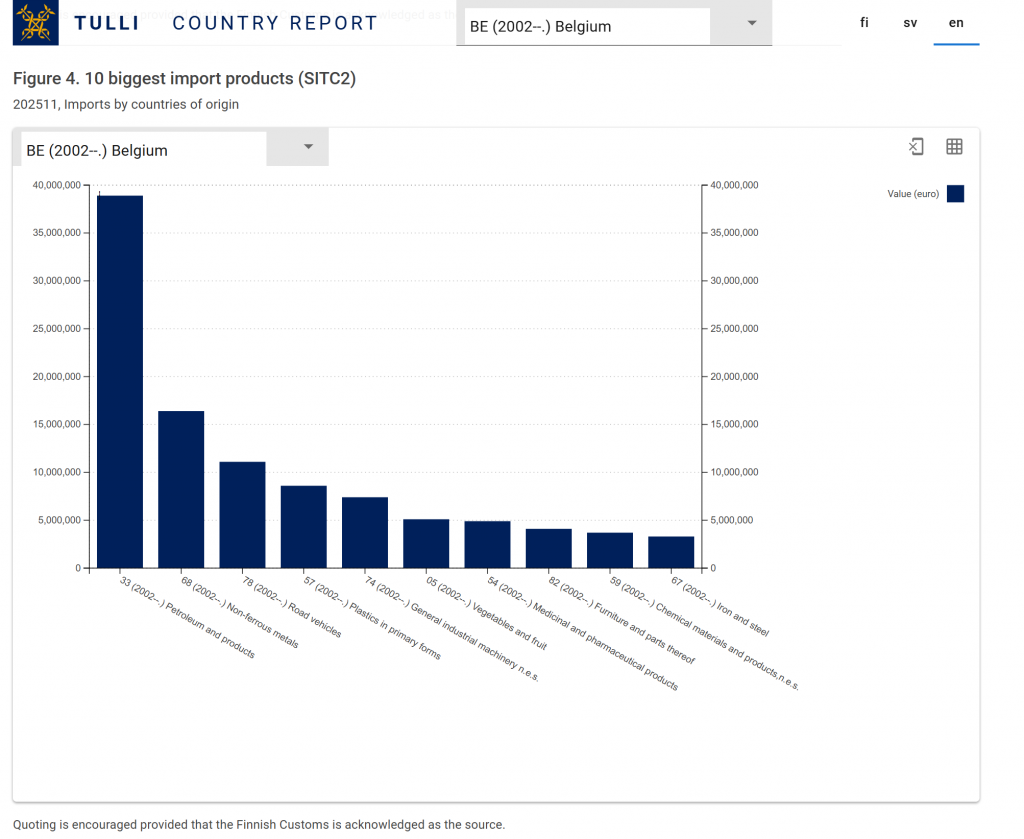
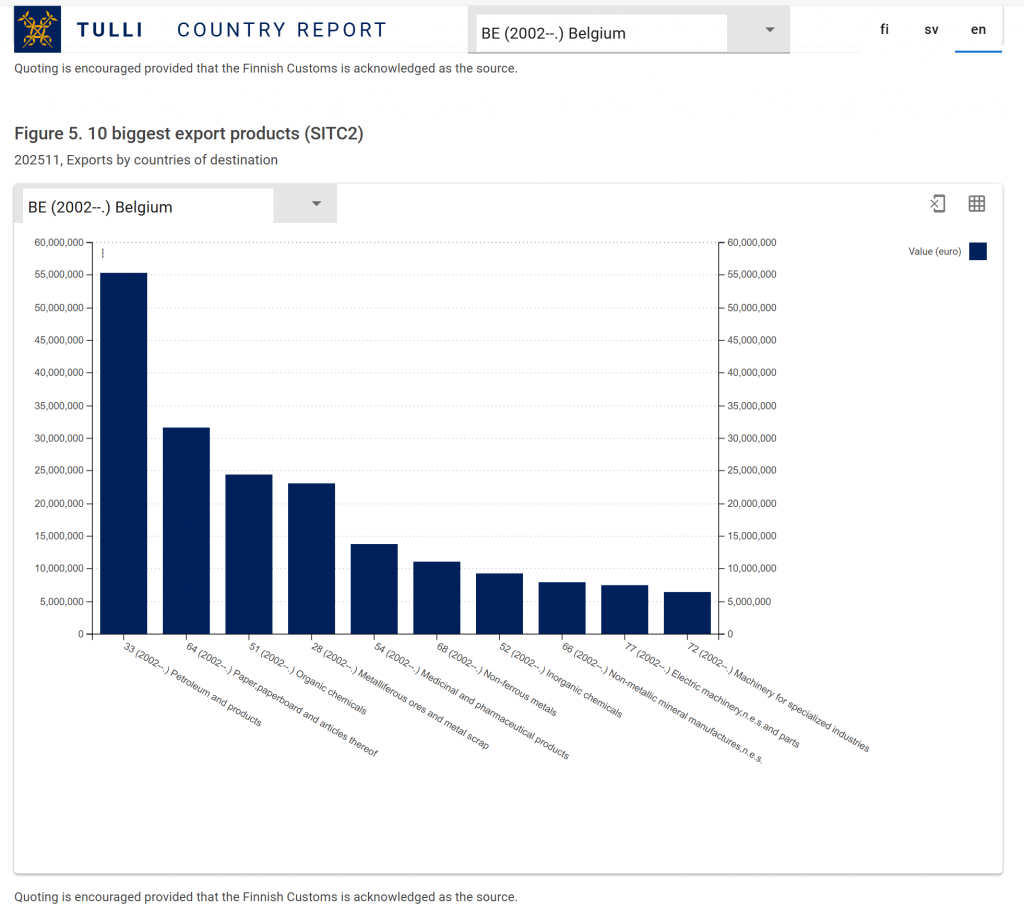
According to statistics provided by Finnish Customs, trade between Finland and Belgium is active, as shown in the report below. Finland exports somewhat more products to Belgium than it imports.
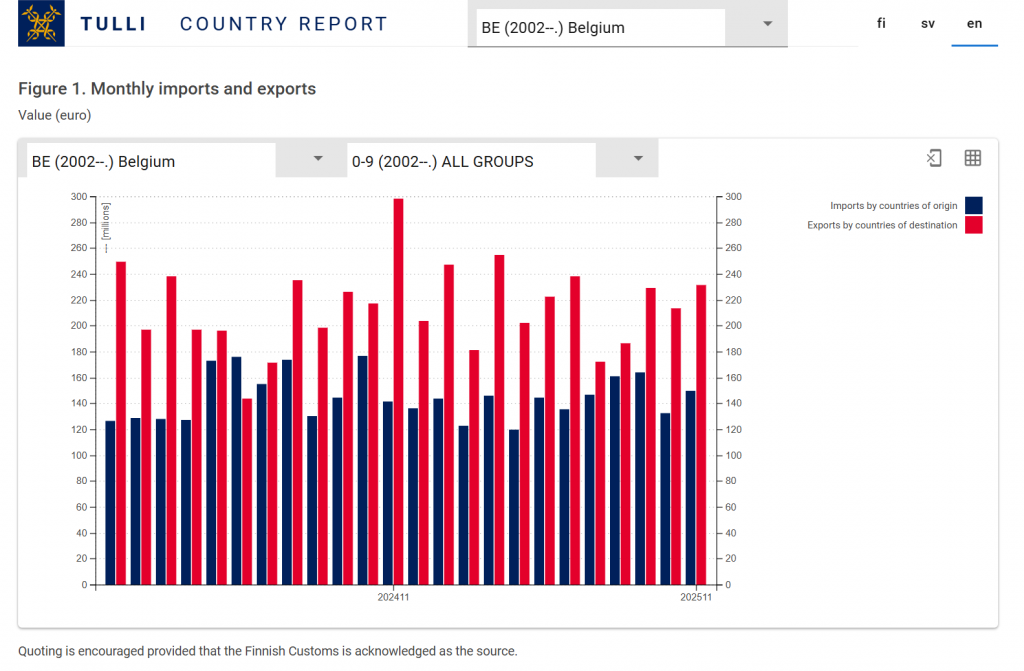
The most imported goods from Belgium to Finland vary from month to month, but in November 2025 the main import categories were petroleum, non‑ferrous materials (various metals), vehicles, plastics, industrial machinery and other similar products.
The largest export categories from Finland to Belgium in November 2025 were petroleum, paper and paperboard, organic chemicals, metalliferous ores and metal scrap, as well as medicinal and pharmaceutical products.
Peppol transaction statistics
The Peppol transaction statistics between Finland and Belgium have not been published, but we can share some analysis based on the available data. The statistics do not reflect the full scale of trade between the two countries, and there is still significant room for growth.
However, a promising upward trend can be seen starting in 2025, particularly in the number of transactions sent from Belgium to Finland. There has also been modest growth in transactions from Finland to Belgium in recent months, even though this flow has remained relatively stagnant throughout the reporting period beginning in 2024.
To understand why the situation looks like this, and why the growth in transactions from Belgium to Finland appears especially strong – we need to take a closer look at the e‑invoicing models of each country.
Finland – e-Invoicing
Finland is an interesting case with over 25 years of history with e‑invoices. Over the years, there has been steady growth in the usage rate of e‑invoices. Currently, over 90% of all invoices are e‑invoices. That means 325 million e‑invoices per year, including B2G, B2B and B2C transactions. In the Finnish national e‑invoicing registry, over 370,000 companies have registered their e‑invoicing capabilities. That is a lot in a country with a population of 5.6 million people.
The vast majority of e‑invoices in Finland are transmitted through a national e‑invoicing network using the domestic formats Finvoice and TEAPPSXML. The national system supports B2G, B2B and B2C transactions. Both domestic formats are EN‑16931 compatible. Given the long history, there are still legacy systems in use that rely on older versions of the formats, which might complicate things.
The system works quite well but can seem challenging from the outside. For a foreign company trading with a Finnish company, the question is: To which address should I send the e‑invoice? If the Finns are using e‑invoices in domestic trade, surely, they can also use them with us.
As you might have guessed the answer is Peppol.
Finland is relatively new to Peppol, as the Peppol Authority was established only in 2023. Currently, only about 13,000 Finnish end users have registered their Peppol capabilities in the Peppol Directory, with a total of 780,000 transactions per year. This is a significant gap compared to the 370,000 registered companies and the 325 million transactions processed annually in the national network.
However, the situation is not as bleak as it may seem at first glance. The number of Peppol transactions in Finland grew by 60.6% last year. Most Finnish companies already use systems capable of e‑invoicing; they simply have not connected to Peppol because e‑invoices have traditionally been exchanged through the national network. Moreover, e‑invoices have not been the default solution in cross‑border trade, as many countries have only recently begun adopting them widely.
Most Finnish national e‑invoicing service providers are also Peppol service providers, which makes the transition straightforward. Converting national formats into Peppol invoices, and vice versa, is technically simple. In practice, Finnish companies may only need a gentle nudge from their foreign trading partners to activate their Peppol capabilities. And from the looks of it, Belgian companies have already started doing just that.
Belgium – e-Invoicing
For a long time, e‑invoicing in Belgium was limited to supply chain automation initiatives in the private sector, often referred to as Electronic Data Interchange (EDI) projects. Over the years, this technology enabled significant digitalization across various trading networks, supported as well by service providers in the IT industry. However, this evolution also resulted in a rather fragmented landscape, which considerably complicated access to e‑invoicing for most public sector entities and small businesses.
In line with the European Directive 2014/55/EU introducing e‑invoicing in the European public sector, Belgian government entities – and their suppliers – progressively adopted Peppol as a common network. Peppol combines strong governance with proven open standards, significantly lowering the barriers to entry.
Building on the foundations laid during the so‑called “B2G phase,” the Belgian government decided in 2021 to proceed with a national rollout of e‑invoicing in the private sector. On the one hand, this supports further digitalization among SMEs; on the other, it contributes to the modernisation of VAT collection. By making all VAT invoices electronic, the implementation of automated VAT data collection becomes substantially more streamlined. Peppol was selected as the “common denominator” (also known as the default network) for e‑invoicing. The law introducing mandatory e‑invoicing for VAT‑liable transactions was promulgated on February 7, 2024, and e‑invoicing has been mandatory since January 1, 2026.
The law applies only to domestic VAT‑liable transactions. However, Belgium expects significant spillover effects for cross‑border transactions and for non‑VAT transactions as well. In the longer term, the impact is expected to extend beyond e‑invoicing and potentially beyond procurement processes. Indeed, the potential of Peppol is not limited to these types of exchanges. The most immediate opportunity lies in cross border transactions with countries and regions that share the same open and cooperative model. With limited promotion within the IT sector, a significant share of cross border invoices between Finland and Belgium could be converted into Peppol BIS invoices within weeks. Once the ease of such gains is demonstrated, it is likely that most of this cross border traffic will gradually follow the same path.
Written by: Hannu Kivinen, the Peppol Authority of Finland, and Serge Libert, the Peppol Authority of Belgium (BOSA)
More on the subject
To learn more about the possibilities of using Peppol in cross‑border cases, join Peppol Day Finland 2026 on 21 April 2026, where Serge Libert from the Peppol Authority of Belgium (BOSA) will give a presentation on Belgium’s e‑invoicing journey. The conference will be held in English.