Public demand shapes entire markets across Europe. Yet businesses often see those markets taking shape only one tender at a time. By then, there is little time to build expertise, form partnerships or develop new solutions. Better information about future needs allows businesses to anticipate where demand is heading and invest where new opportunities are beginning to emerge.
It is still quiet in Liisanpuisto in Helsinki’s Kruununhaka district when Sanna-Maria Bertell, Senior Adviser at the Confederation of Finnish Industries, meets Seija Friman, Project Director at the Finnish State Treasury. After catching up, their conversation turns to decisions whose effects remain visible across society long after the tendering process itself has been forgotten.
Public procurement is everywhere: in roads, buildings, public transport and digital services. Around EUR 2.6 trillion changes hands through public procurement in the European Union each year, equivalent to roughly 15 per cent of the EU’s gross domestic product.
Yet one of Europe’s largest markets has been difficult to see as a market. Instead, it has taken the form of thousands of separate calls for tenders, contracts and purchase invoices. Each records a single decision. The direction of the market becomes visible only when those decisions are considered together.
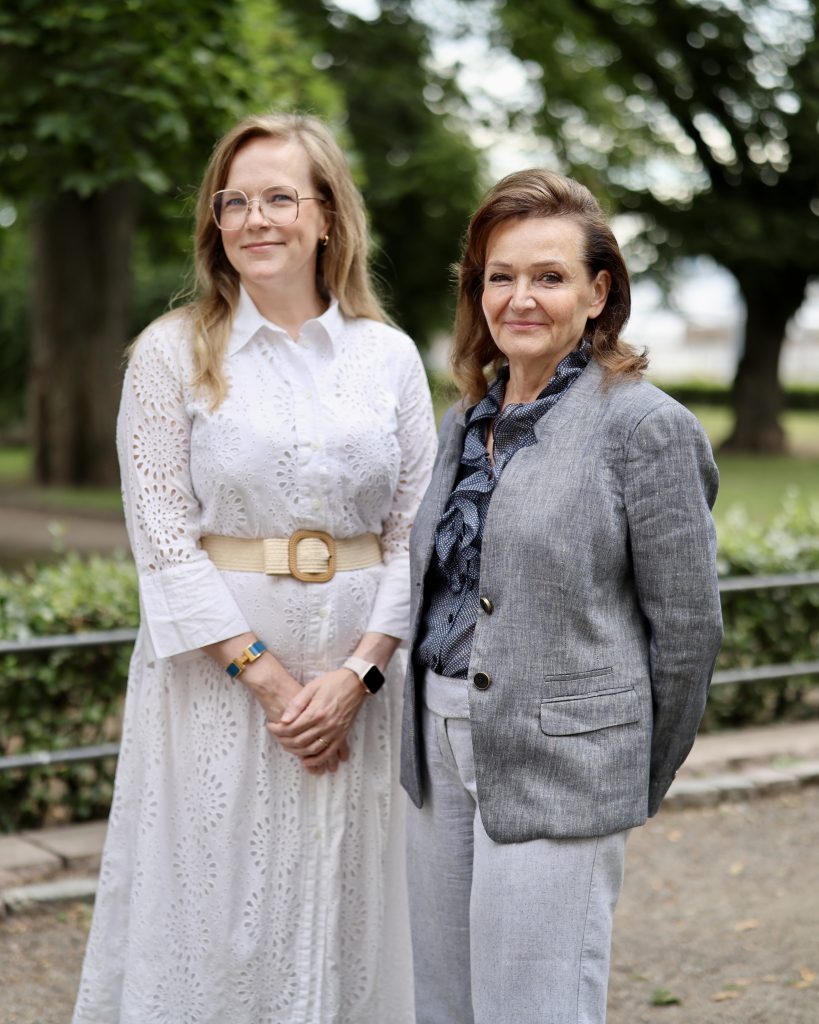
The same information offers two perspectives. Seija Friman, right, examines public procurement through the lens of decision-making and impact, while Sanna-Maria Bertell approaches it from the perspective of markets and businesses.
Until now, the data has mainly offered a view of the past. For the market, however, the crucial question is about the future: what will the public sector buy next?
What an invoice cannot tell us
When Friman began her career in central government in the 1980s, information travelled on paper. Over four decades, paper has given way to systems, and systems to data. Today, a single procurement may leave a record in an e-tendering service, a case management platform, a contract management solution and several financial management applications.
Friman points out that these systems do more than simply store information.
“Introducing an information system is never just about the system itself. It also changes processes, the division of responsibilities and the way work is done. The value of data becomes apparent only when it changes decisions,” Friman says.
A successful procurement often goes unnoticed. When a day-care centre works as it should, a road is properly maintained and a bus arrives at its stop on time, few people stop to consider the tendering processes and contracts behind them.
“The best procurements are invisible. People do not notice them, but their daily lives work better because of them,” Friman says.
The harder question is why one procurement succeeds while another does not. There is a wealth of information about tendering processes and expenditure, but it has been difficult to use that information to determine what kinds of solutions improve services, strengthen competition or deliver better value for public money.
A call for tenders tells us what the buyer intended to purchase. A contract tells us which supplier was selected. A purchase invoice tells us how much was paid. In Finland, public-sector organisations purchase goods and services worth between EUR 40 billion and EUR 50 billion each year. The financial flows are documented in detail, but far less is known about the impact of those procurements.
Competition begins before the tender
Businesses would benefit from knowing what public organisations plan to purchase a few years from now. An individual call for tenders, however, does not reveal whether it represents an isolated case or a broader shift.
Entering a new market takes time. A company may need to develop its solutions, build expertise and, in some cases, change its entire way of operating. The sooner future demand becomes visible, the more time companies have to prepare to compete.
Bertell gives the example of a local food producer. The entrepreneur may see individual procurement notices, but not how much of the same type of product is being purchased across the wider market or when existing contracts are due to expire. Bringing together information from different contracting authorities would allow the business to assess demand, plan production and take part in market dialogue before the tendering process begins.
“Information about the purchases of a single contracting authority is not enough for a business. It needs to see demand across its entire market area. I believe this information will help entrepreneurs identify new business opportunities,” Bertell says.
Not all businesses will be able to benefit from open data at the same pace. Those with the greatest resources are likely to be the first to make use of it. According to Bertell, what matters is that every business has access to the same information on equal terms.
Nor should every company need to build its own analytics team. Services could emerge around open procurement data, turning it into useful intelligence, particularly for small and medium-sized enterprises. According to Bertell, the public sector’s role is not to develop these services, but to ensure that the underlying data is reliable, consistent and machine-readable.

“Businesses do not invest in the past. They invest in what they believe will happen next,” Bertell says.
Where demand takes shape
Finland is developing a national public procurement data repository that will bring together information on tendering processes and actual purchases, as well as purchase invoices from central government, municipalities, wellbeing services counties and the Social Insurance Institution of Finland. Taken together, the data could reveal the broader direction of public demand.
If several cities are preparing similar investments, their combined demand may create a market that no individual company can yet see in its entirety. For a business, that information could influence whether it develops a new solution, recruits additional specialists or partners with others on a larger bid.

Businesses often must make investment decisions long before a call for tenders is published. For Bertell, the value of procurement data lies in how early it can help businesses see future demand.
For Friman, the crucial question is whether the public sector can use the same information to improve its own decisions. Contracting authorities could compare their approaches, identify risks and recognise when collaboration with other public buyers is warranted. Bertell, meanwhile, emphasises that the data should not remain confined to administrative reporting or oversight. It should reach the market and help businesses assess which kinds of solutions are likely to be in demand.
“If information reaches the market efficiently, a solution will be found,” Bertell says.
Friman sees an even broader possibility.
“If we succeed in making use of the information, procurement will become more than a way of purchasing services. It will become a means of making better decisions and generating greater impact from every euro of public money spent.”
Better decisions do not, however, emerge from comparison alone. The data repository under development is intended to enable nationwide comparisons of tendering processes and purchases. In the future, it could reveal, for example, declining competition, rising prices or changes in procurement practices. The repository’s greatest value, however, lies not in individual indicators, but in its ability to identify phenomena that warrant closer investigation.
“The public procurement data repository addresses the problem of access to information, but it does not automatically solve the problem of understanding. Procurement data tells us what happened, but only rarely why it happened or whether the outcome was the best possible one,” Friman says.
Information about a tendering process, supplier, price and purchasing volume does not tell us whether service quality improved, whether users were satisfied or whether the procurement reduced costs elsewhere. Although the repository will not provide ready-made answers, it can help identify the questions worth investigating. The same information could also offer a view of markets beyond Finland.
A European market comes into view
Public organisations across Europe purchase similar services, technologies and infrastructure. A company’s potential market may extend across national borders, even though information about that market remains scattered across national systems.
In the construction sector, for example, simultaneous investment by several countries in low-carbon construction, energy-efficient renovation or transport infrastructure may add up to a significant market. In any single call for tenders, this shift may appear as little more than a minor detail. When data from different countries is viewed side by side, the true scale of the demand begins to emerge.

“Information can show us what happened. Leadership begins with deciding what to do based on it,” Friman says.
Comparing data across countries requires a common structure. The EU’s eForms data model has turned procurement notices into more structured and comparable data.
“You could say that eForms moves procurement information from documents to data. That is precisely what enables the next stage of data-informed decision-making,” Friman says.
The Public Procurement Data Space, or PPDS, brings together data from the European Union and its Member States for cross-border analysis. Bertell sees the PPDS as an opportunity to make European markets more accessible to businesses. Presented in a common and comparable format, the data can help companies assess their competitiveness and identify opportunities beyond their domestic market.
“If successful, this represents a significant opportunity to remove barriers within the single market. Finland must help ensure that common standards support open competition rather than add to the administrative burden,” Bertell says.
What comparison leaves out
It remains difficult to form a comprehensive picture of Europe’s public procurement market. Information on procurements below EU thresholds is fragmented across national and regional systems, and existing datasets do not provide consistent coverage of the entire procurement lifecycle. Shortcomings also remain in data quality and interoperability.
According to Friman, the purpose of comparing countries is not to rank them. Viewed side by side, procurement decisions can show how different parts of Europe are responding to the same societal challenges. A solution adopted in one country may serve another as a point of comparison, a warning or an example of a new opportunity.
Comparison also carries risks. Similar-looking figures may reflect different operating environments, market structures and procurement objectives. Yet an abundance of data, presented through compelling visualisations, can create the impression that cause and effect are understood even when the data shows only associations between different phenomena.
“A solution that worked in one environment may then be copied into another without understanding the conditions that made it successful. In my view, the greatest risk is not a lack of information, but a false sense of certainty,” Friman says.

Data does not provide ready-made answers, but it can help us ask better questions. For Friman and Bertell, what matters is what the information enables us to see.
For a business, competitive advantage rarely comes from finding the same call for tenders as everyone else. What matters more is seeing before others where public demand is heading, what kinds of investments are being prepared in different countries and which solutions the market may be ready for next.
“We are talking about information that can influence where the next wave of growth, the next investments and the next innovations will emerge. The better information flows, the better markets work and the more effectively public funds are used,” Bertell says.
European public procurement already crosses national borders. Now the information should do the same.
What will the market see next?
After the interview, Friman and Bertell set off along a street lined with Art Nouveau buildings. Lunchtime is approaching. A tram rattles along the tracks, someone searches for a parking space, and a dog walker greets them as they pass.
Out on the street, the subject of their conversation is suddenly everywhere. The street network, buildings and transport system are the result of public decisions made over many years. Their mark is visible in the cityscape, yet we still understand only part of the market those decisions have created. Finland’s national public procurement data repository is still under development, and a complete picture of the European market has yet to emerge.
By the time the market becomes visible through a series of separate calls for tenders, many of the crucial decisions have already been made. The question now is whether the direction of the market can be seen while there is still time to influence it.
****
Text and photos: Henni Purtonen
Sanna-Maria Bertell is a lawyer specialising in competition law and public procurement at the Confederation of Finnish Industries (EK). Her background spans the private sector, international roles and business advocacy. Bertell examines public procurement through the lenses of well-functioning markets, competition and business growth, with particular attention to the opportunities it can create for companies.
Seija Friman has extensive experience in public procurement, financial management and digital transformation in central government. Her background spans the modernisation of government financial and HR administration, the digitalisation of public procurement and the use of procurement data. Friman believes that successful transformation is built on knowledge, collaboration and broad participation.